
The conversation about AI at the border is almost entirely about capability: faster clearance, sharper risk targeting, better detection. These are real gains, and the technology behind them is improving quickly. But there is a question we are not asking loudly enough, and it is the one that matters most for any public institution: not what AI can do, but whether we can govern it.
The border is where artificial intelligence meets national sovereignty. A decision to flag a traveler, hold a shipment, or question a document is an exercise of state authority. When an algorithm shapes that decision, the institution does not shed its accountability. It deepens it. Yet the governance frameworks to manage that accountability are, in most places, simply not there.
I spent nine years as CEO and Commissioner of the Jamaica Customs Agency. I know what it means to be accountable for a decision made at the border, to a minister, to a traveler and to the public. So I do not come to this as a technologist. I come to it as someone who has held the responsibility that AI is now being asked to share, and who understands that the responsibility never actually transfers. The system may make the recommendation, but a human institution still answers for it.
That is the heart of the matter. As AI moves to the frontline of border management, three questions should keep every leader awake.
First: Can We Explain Our Decisions?
Many of the most capable systems are, in effect, black boxes. They produce a score or a flag, but the reasoning is opaque even to the people who operate them. At the border, where a decision can affect a person's liberty, a trader's livelihood, or a country's revenue, an unexplainable decision is a governance failure waiting to happen.
I continue to stress the importance of transparency in the design of these solutions, and I am encouraged to see emerging AI solutions offer a clear and sensible rationale for human interpretation and decision support.
Second: Where Does Human Judgment Sit?
The most important design choice in any border AI system is not technical. It is the level of human involvement. Is a person in control of each consequential decision, supervising the system's outputs, or absent from the loop entirely? The greater the potential for irreversible harm, the closer a human must remain to the decision. That is a governance judgment, not a software setting.
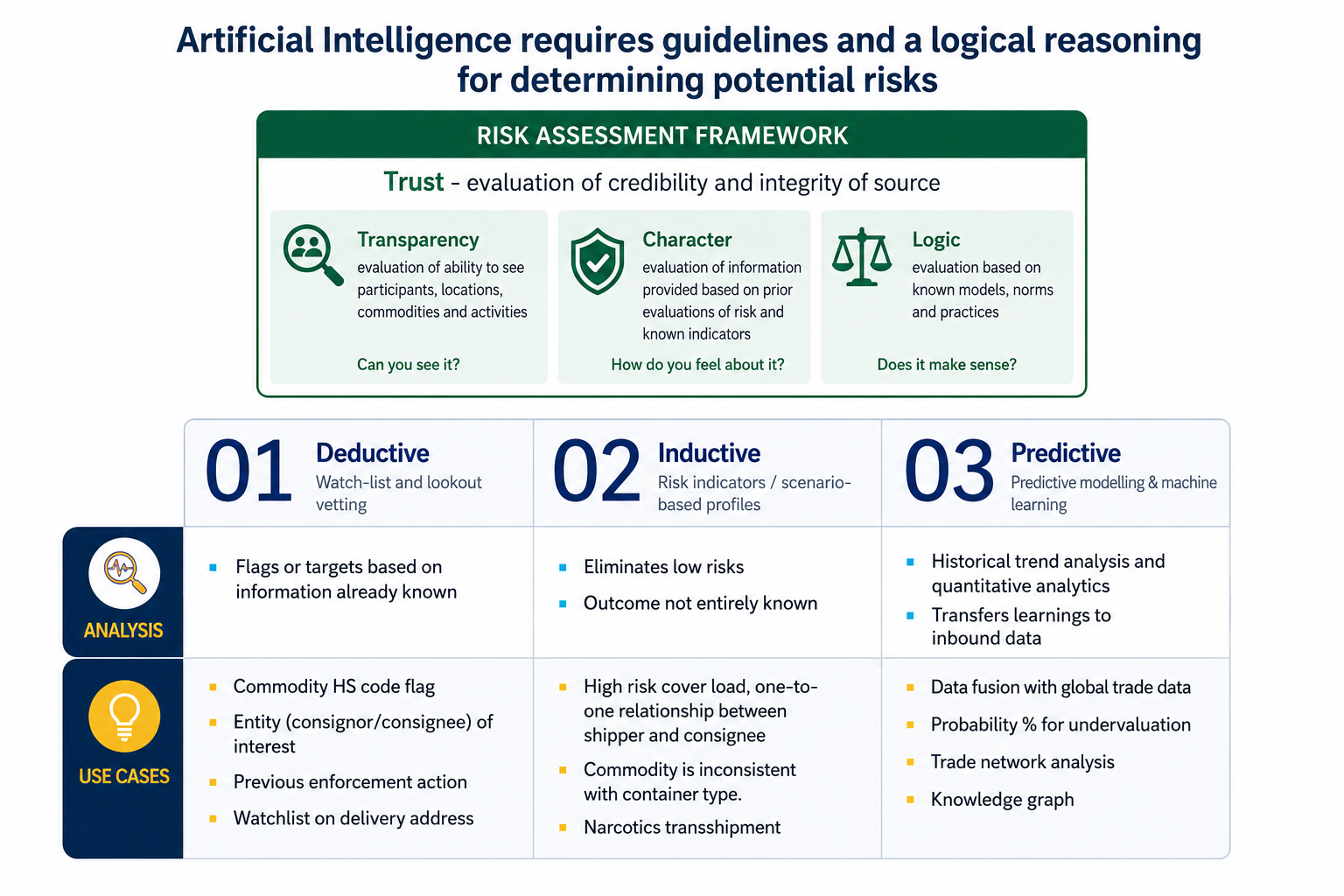
AI is now measuring the trust and credibility associated with a shipment, conveyance, or traveler. In a system, those subjects become data objects. Measuring trust and credibility of a data object requires a framework based on transparency (can we see it?), character (how do we feel about it?), and logic (does it make sense?)
Some systems are beginning to get this right by making their reasoning legible to the humans who use them. More should. The framework below illustrates how AI risk assessment at the border can be structured to maintain that transparency across deductive, inductive, and predictive analytical modes:
Third: Are We Ready for the Rules Now Arriving?
The regulatory environment is tightening. The European Union's AI Act now reaches institutions far beyond Europe. Data protection, cybersecurity, and data sovereignty obligations apply with particular force when border data is processed or stored across jurisdictions. An institution that cannot demonstrate how it governs its AI is increasingly at risk of legal and reputational harm.
None of this is an argument against AI at the border. It is an argument for governing it well, so that its benefits can be realized with confidence rather than anxiety. Technology providers who take governance seriously are not constrained by it. They are made more credible by it, because their clients can adopt their tools knowing the accountability questions have been answered.
The GUARD Framework
This is the work I now focus on. Over the past months, I have developed the GUARD Framework, an AI governance assessment methodology for public institutions, with particular attention to the realities of smaller and developing states that large international frameworks often overlook. It is my independent work.
The GUARD Framework assesses how an institution governs its AI across five dimensions: mapping every system in use, understanding the risks each poses, building accountability structures that keep humans in control, aligning with the regulations now in force, and producing a practical roadmap for improvement. It is grounded in international standards, including the World Customs Organization's guidance on AI in customs, and is designed to be implemented by institutions with real-world constraints, not just well-resourced ones.

In our assessments to date, the most consistent finding is not a technology gap. It is the absence of any designated accountability owner for AI decisions. The systems exist. The responsibility for them often does not.
The border has always been where a nation asserts its sovereignty most directly. As we bring artificial intelligence to that frontier, we should adhere to a simple principle: the more capable the technology, the more deliberate the governance must be. Capability and accountability are not opposing forces. The institutions that get this right will be the ones that adopt AI not just quickly but wisely.