

I began my career with Australian Customs in 1982 and spent the following four decades working in, and consulting to, customs administrations across Europe, Africa, Asia, and the Pacific. The specific challenges change with geography, and a Pacific island nation has different constraints from a Southeast Asian emerging economy, but the underlying dynamics of customs modernisation are remarkably consistent wherever you go.
This is what I have learned.
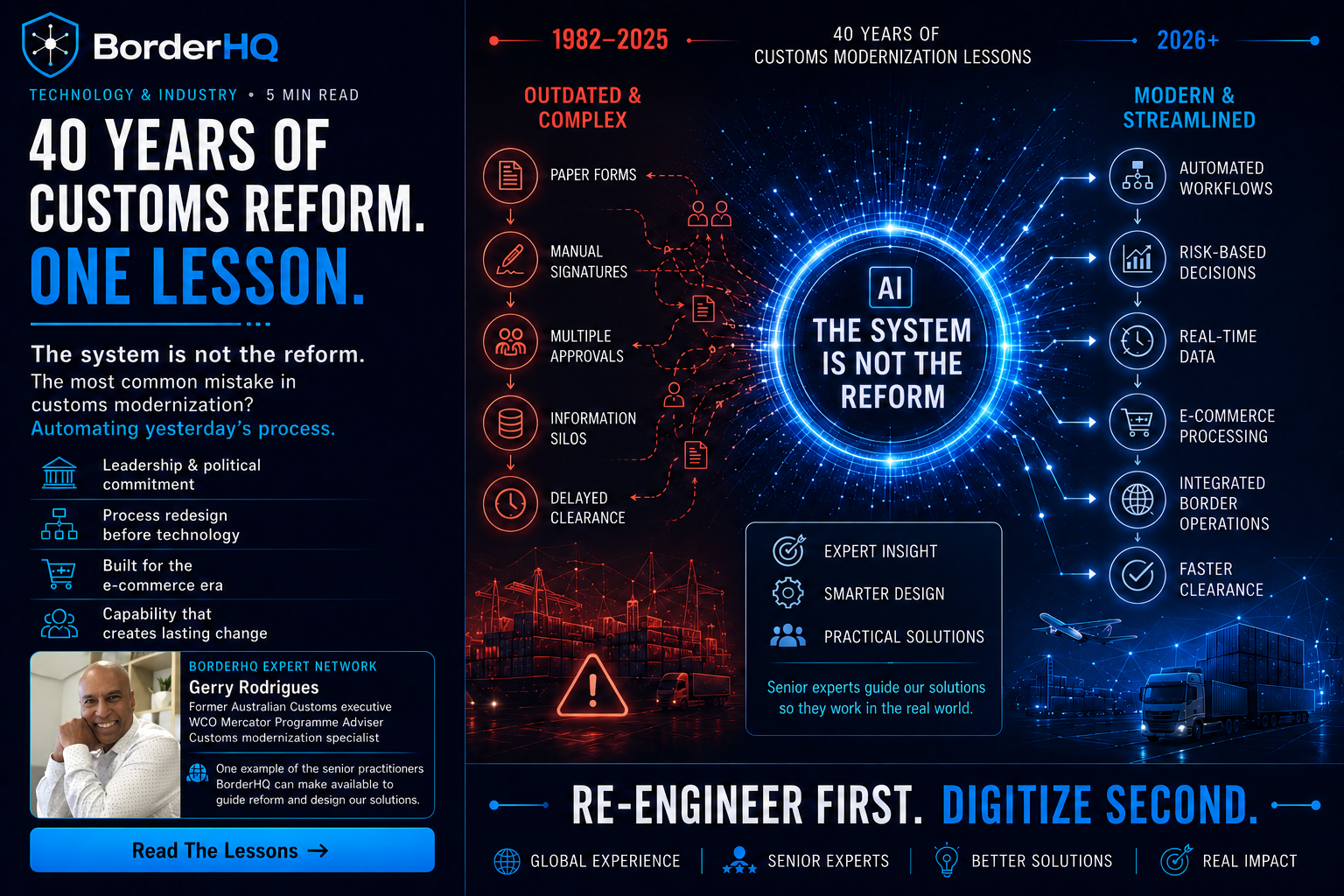
Four decades of customs modernisation experience across Europe, Africa, Asia, and the Pacific.
Modernisation Is a Political Project as Much as a Technical One
Every successful customs modernisation I have been part of has had visible, sustained political commitment from the highest level of government. Every failed one has not. This is not coincidental. Customs modernisation threatens established interests: corrupt officials, brokers who profit from process complexity, traders who have built their operations around existing procedures. Those interests resist change. Only political authority can overcome that resistance.
Reformers who believe that demonstrating technical superiority will be sufficient to drive adoption are consistently disappointed. The technical case is necessary but not sufficient. The political case must be made explicitly, and the political leadership must be prepared to manage the resistance that follows.
Process Before Technology
The single most common mistake in customs modernisation, and I have seen it in every region I have worked in, is automating the existing process rather than redesigning it. If the underlying clearance process is inefficient, automating it produces a faster, more expensive version of the same problem.
Business process re-engineering must precede system selection. Map the current process in detail, including every touchpoint, every document, and every decision point. Then ask: which of these touchpoints add value? Which exist only because of a constraint the new system makes obsolete, such as a paper form, a manual signature requirement or a legacy regulation?
The E-Commerce Challenge
One of the most significant and underaddressed challenges in contemporary customs modernisation is the explosion of e-commerce cross-border trade. Low-value consignments arriving through postal and express channels in volumes that existing processing systems were never designed to handle have created a genuine operational crisis for many customs administrations.
The traditional response, de minimis thresholds that exempt most e-commerce from duty, is fiscally unsustainable and creates significant competitive distortions between domestic retailers and foreign online platforms. Agencies need purpose-built processing architectures for e-commerce, not adaptations of commercial cargo systems.
Capacity Building That Sticks
International technical assistance in customs is frequently delivered as a project: a team arrives, delivers training, completes a diagnostic, writes a report, and leaves. The host administration gains new knowledge that, without continued reinforcement and institutional embedding, dissipates within months.
Effective capacity building requires transfer of capability, not just transfer of knowledge. That means training trainers, embedding reformed processes in standard operating procedures, creating internal champions with the authority to sustain change, and scheduling follow-up engagements that hold the reform programme accountable over time.