

For most of customs history, risk targeting was a human art form. An experienced officer would review a manifest, draw on years of pattern recognition, and make a call. That instinct, invaluable as it was, could not scale. It could not process ten thousand declarations a day, cross-reference real-time intelligence feeds, or update its own model based on what it learned at 2am.
The shift to automated risk scoring has been underway for two decades, but the arrival of genuine machine learning, as distinct from rules-based selectivity, represents a categorical change in what is possible at the border.
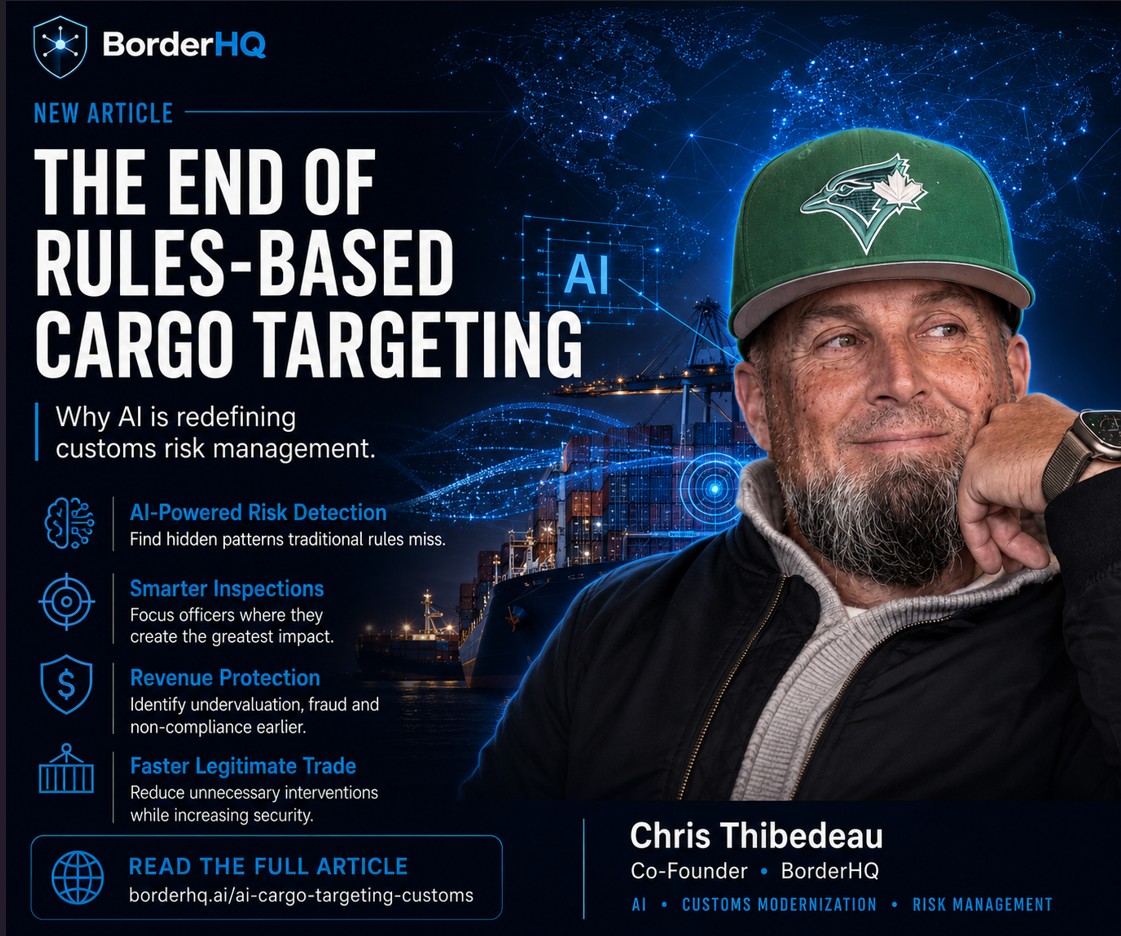
Why AI is redefining customs risk management: sharper detection, smarter inspections, and stronger revenue protection.
The Limits of Rules-Based Systems
Rules-based selectivity engines work by encoding known risk indicators: country of origin, commodity type, importer history, route anomalies. When a declaration matches enough rules, it is flagged. This approach is transparent, auditable and politically defensible, but it has a fundamental weakness: it can only find what you already know to look for.
Sophisticated smuggling operations learn the rules. They fragment shipments below threshold weights, rotate origin declarations, build compliant trade histories before pivoting to illicit cargo. A static rules engine, no matter how well tuned, is always catching yesterday's threat.
What Machine Learning Changes
The TITAN automated risk assessment system, developed during my tenure at the Canada Border Services Agency and recognised with a GTEC Gold Medal and the Canadian Public Service Award of Excellence, demonstrated that automated systems could outperform manual targeting, by making human judgment available at scale rather than replacing it.
Modern ML-based risk engines operate differently from their rules-based predecessors in three critical ways:
They learn from outcomes. Every inspection result, whether seized, clean or compliant, feeds back into the model. The system improves continuously rather than waiting for a policy analyst to update a rule.
They detect anomaly, not just known patterns. An ML model can identify a shipment that has no specific risk indicator but is statistically unusual in ways that no rule would capture.
They process multi-dimensional data simultaneously. Manifest data, importer history, route data, financial intelligence, and open-source feeds can all be weighted together in real time.
Implementation Realities
Agencies considering AI-driven targeting must resist the temptation to treat it as a technology project. It is an operational change project with a technology component. The most common failure mode is deploying a sophisticated model on poor-quality data. Garbage in, garbage out applies with particular force when the model is too complex for officers to understand what it is flagging and why.
Explainability is an operational concern as much as a regulatory one. Officers need to trust the system enough to act on its outputs. That requires transparency in how scores are generated, feedback mechanisms that let officers report false positives, and regular review cycles where domain experts challenge the model's assumptions.
The Road Ahead
The border agencies that will lead the next decade are those building the data infrastructure today. Clean, structured declaration data. Consistent inspection outcome recording. Interoperable intelligence feeds. The model is only as good as what you feed it. Get the data right, and the targeting capability that follows will be transformative.
At BorderHQ, we are building on the lessons of TITAN and a generation of customs AI deployment to help agencies make that transition operationally as well as technologically.