

The World Customs Organization's diagnostic assessment process is one of the most valuable, and most frequently misunderstood, tools available to customs modernisation practitioners. Over 30 years in Canadian government border management, including accreditation as a WCO Diagnostic Facilitator and diagnostic missions to Peru, Nicaragua, and Algeria, I have seen the process work brilliantly and I have seen it squandered.
The difference almost always comes down to how the receiving agency approaches the exercise.
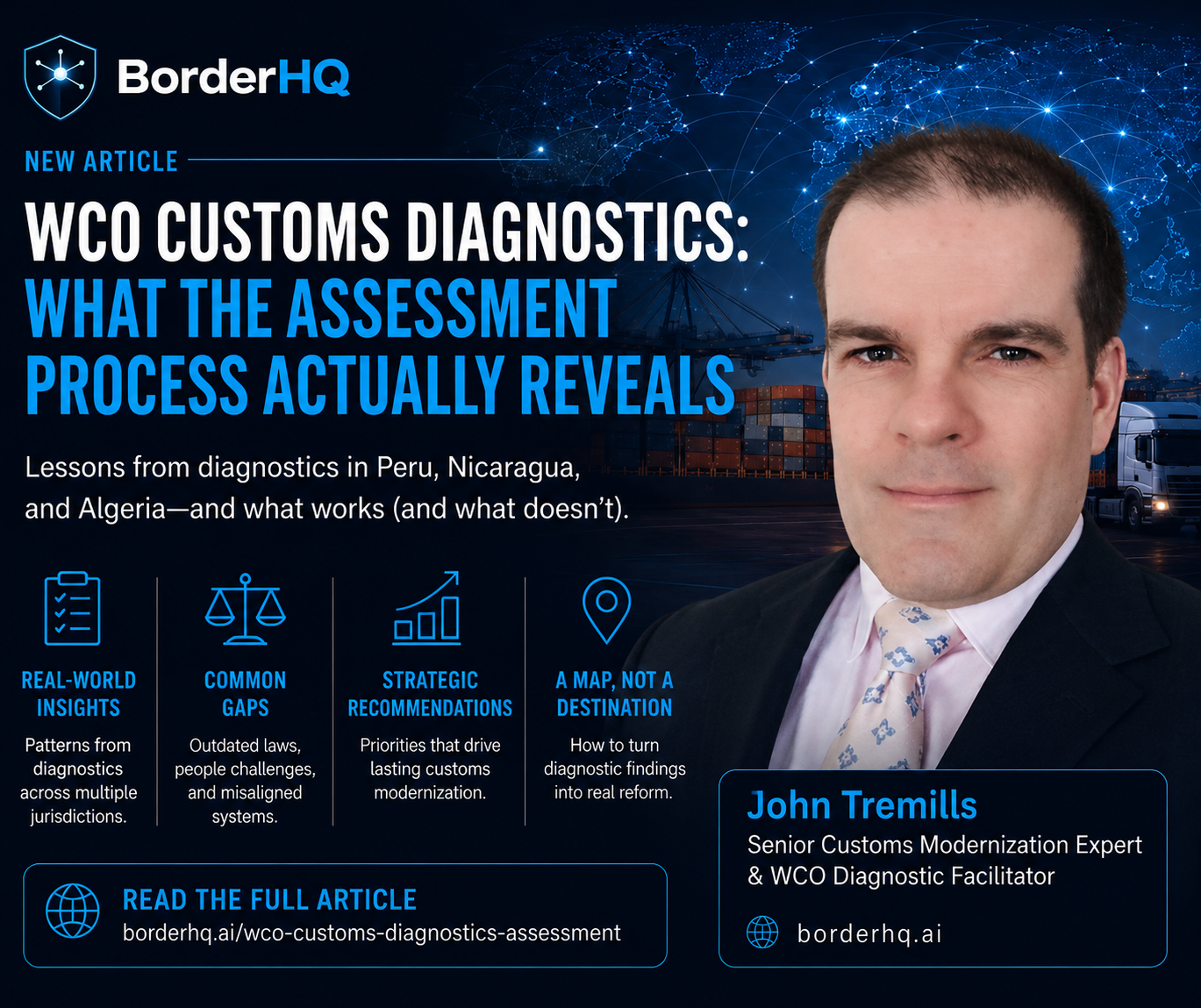
Lessons from diagnostics in Peru, Nicaragua and Algeria: what works, and what doesn't.
What a WCO Diagnostic Actually Measures
The WCO Customs Capacity Building Diagnostic Tool assesses an agency against the WCO's Revised Kyoto Convention standards across a comprehensive set of functional areas: legal framework, organisational management, human resource management, enforcement, customs procedures, trade facilitation, and ICT systems.
The output is a maturity rating for each area and a set of prioritised recommendations. What it is not is a compliance audit or a ranking exercise. The diagnostic is meant to be a collaborative process that helps an agency understand where it is, where it needs to go, and what the path between those points looks like.
Common Patterns Across Diagnostics
Having participated in diagnostics across multiple jurisdictions, and having helped represent Canada's CBSA in technical exchanges with foreign governments, I can identify several patterns that appear consistently:
Legal frameworks are almost universally outdated. Most agencies are operating under customs legislation that predates electronic commerce, advance data requirements, and modern risk management concepts. Modernising the legal framework is typically the most politically challenging recommendation, and the most foundational.
Human resource management is consistently the weakest area. Training programmes are often disconnected from operational needs. Career pathways for customs professionals are unclear. Succession planning is minimal. Agencies invest in systems but not in the people who operate them.
ICT systems are frequently misaligned with operational processes. Technology has often been deployed to automate existing paper-based processes rather than to redesign those processes around the capabilities the technology enables.
Getting Value from the Diagnostic
Agencies that get the most from a WCO diagnostic share several characteristics. They engage senior leadership throughout the process, not just as sponsors but as participants. They are honest in their self-assessment rather than presenting an optimistic picture. And critically, they treat the diagnostic recommendations as the beginning of a multi-year reform programme, not a checklist to be addressed in six months.
The diagnostic is a map, not a destination. An agency that understands this will use it well. An agency that treats it as a performance review will miss most of its value.