

Revenue leakage in customs is one of the most significant and least publicly discussed fiscal problems facing developing economies. Undervaluation, tariff misclassification, false origin declarations, and outright fraud collectively cost governments billions of dollars in foregone duty revenue every year. In some jurisdictions, the leakage represents a substantial fraction of total customs revenue, and marks the difference between a customs administration that funds itself and one that requires subsidy.
Having spent 32 years with the Canada Border Services Agency specialising in criminal investigations, audit and revenue integrity, I can say with confidence that most agencies are not capturing the majority of recoverable revenue that is available to them.
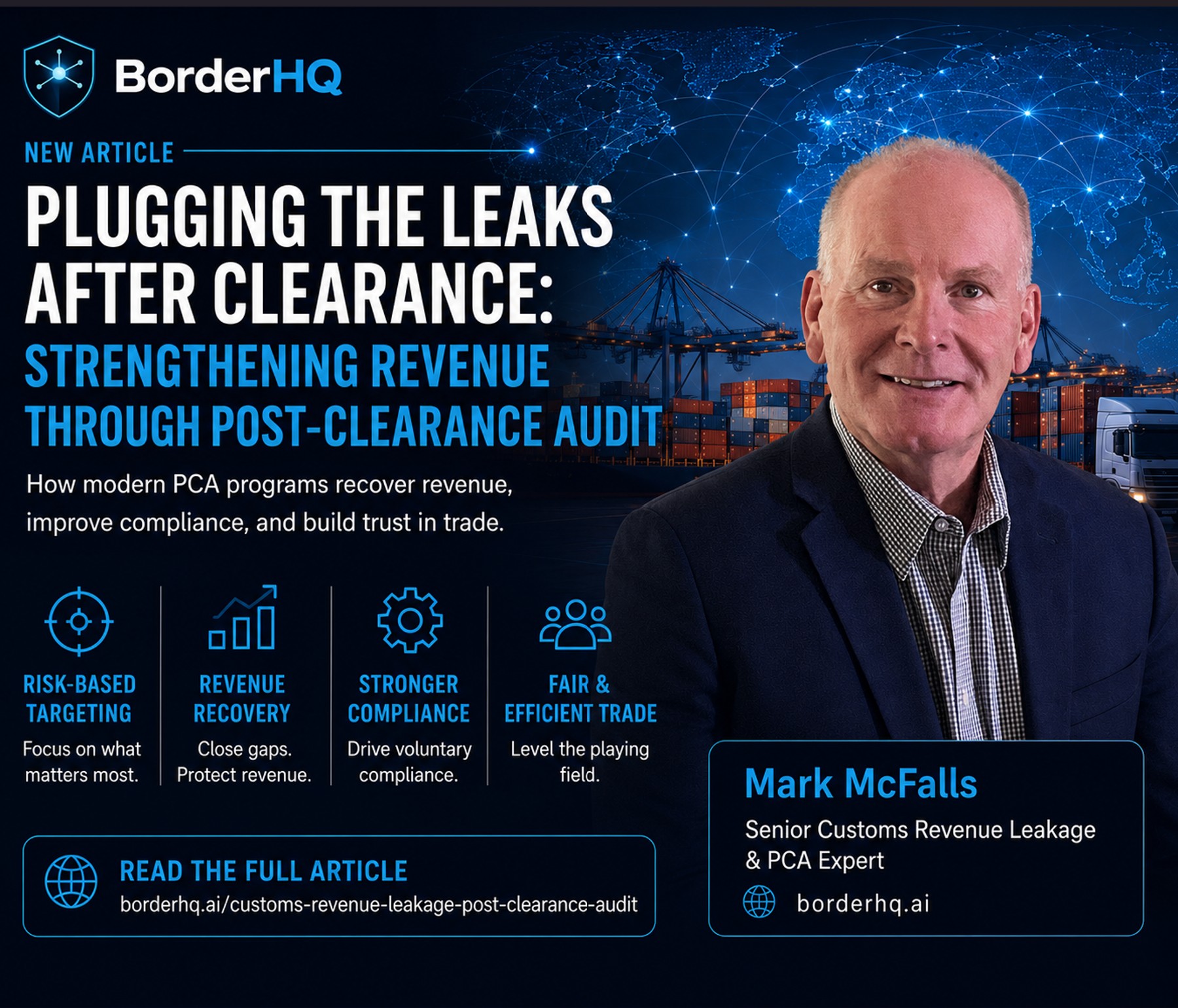
The Three Main Leakage Vectors
Revenue leakage enters through three primary channels, each requiring a distinct investigative approach:
Undervaluation. Goods are declared at a value below their actual transaction value. This may involve related-party transactions where transfer pricing is manipulated, or straightforward false invoicing. The WTO Customs Valuation Agreement provides the legal framework for challenging declared values, but applying it consistently requires trained auditors and access to reference price data.
Misclassification. Goods are assigned to a tariff heading that attracts a lower duty rate than the correct classification. Some misclassification is inadvertent, since the Harmonized System is complex, but patterns of systematic misclassification in high-duty categories are rarely accidental.
Origin fraud. Goods from high-tariff countries are routed through lower-tariff jurisdictions with fraudulent certificates of origin. This has become increasingly sophisticated as preferential trade agreements have proliferated.
What Post-Clearance Audit Can Recover
PCA is the systematic examination of traders' records after goods have been released from customs control. Unlike transaction-by-transaction inspection at the border, PCA allows auditors to examine patterns across an importer's entire trade history, which is where systematic leakage becomes visible.
A well-structured PCA programme, targeting importers selected through risk-based analysis, will typically recover between three and eight times the cost of the audit function in additional revenue. The ROI on PCA is among the highest of any customs enforcement activity.
Building a PCA Programme
Agencies building or strengthening a PCA function should prioritise the following elements:
Legal authority. Auditors need clear statutory access to trader records, including third-party documents such as supplier invoices, freight records, and payment documentation.
Risk-based selection. PCA resources are finite. Audit targets should be selected on systematic risk indicators rather than at random: high-duty commodities, related-party importers and statistical anomalies in declared values.
Trained auditors with trade finance knowledge. Effective PCA requires auditors who understand not just customs law but commercial documentation, transfer pricing principles, and supply chain structures.
A consequence management framework. Voluntary disclosure programmes, penalty structures, and prosecution thresholds all need to be clear and consistently applied. Deterrence depends on predictability.
The revenue that a well-designed PCA programme can recover does not always require new laws or new technology. It requires audit capacity, legal authority, and the institutional will to use them.