



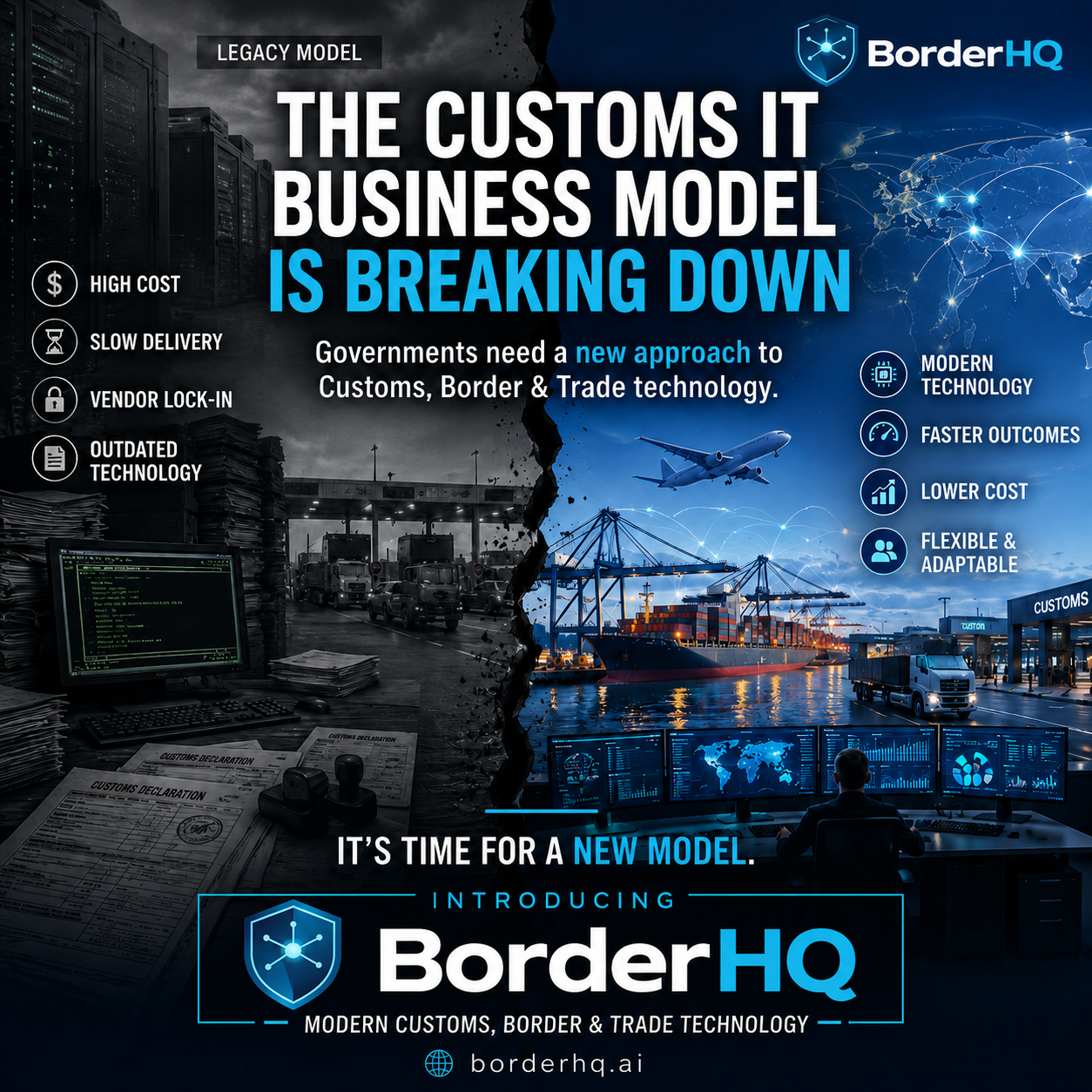
For three decades, customs modernisation has run on a single business model. A country issues an RFP. A small group of established vendors compete. The winner spends eighteen to thirty-six months on the ground with a small army of consultants, painstakingly configuring software to match the country's tariff codes, valuation rules, exemption regimes and political sensitivities. The contract value is split roughly equally between licence fees and the bespoke build that makes those licences usable. The system goes live, and the vendor settles in for a decade of maintenance revenue.
The model has produced a handful of large incumbents, an entrenched UN-backed option in ASYCUDA, and a steady output of customs systems that work well enough, and approximately zero technological breakthroughs since the Electronic Single Window concept arrived in the mid-2000s.
It is about to stop working. This piece is about why, and what we are building at BorderHQ to be ready when it does.
The Customer's Reality, In One Paragraph
If you run a customs agency today, the position is familiar. Your seizure rate has not moved in five years. Your IMF revenue target sits on the minister's desk and there is no obvious lever that will close the gap. The consultants who configured your current platform left two years ago and took the institutional knowledge with them. Your single-window upgrade has been "next year" for four years running. The frustration is not that the technology does not work. It is that the technology has stopped getting better.
Three Things Change At Once
1. The implementation bill collapses
Today the bulk of the price tag and almost all of the timeline goes to consultants who manually translate the country's regulatory environment into rules, tables, codes and workflows. They read the customs act, map the tariff schedule, interview policy officers, sit in port offices documenting what officers actually do versus what the manuals say. Eighteen months, give or take, with a team of fifteen to forty people billing day rates.
Modern language models can ingest a country's customs act, tariff schedule, ministerial decrees and procedural manuals and produce a working draft configuration in days. The work consultants currently do is exactly the kind of structured document interpretation language models now perform at near-human accuracy. Edge cases, local nuance and validation against transaction data still require expertise, but eighteen months becomes six weeks, and forty consultants become six. The economics flip.
2. The system stops freezing on go-live day
Today's customs platforms are transaction processors with a rules engine bolted on. Risk scoring is built on hand-crafted rules written by intelligence officers, updated quarterly, evaluated against last year's seizure data. The system catches what it has been told to catch.
A learning system is a different animal. It classifies goods at a level that exceeds human officers, detects undervaluation by recognising patterns across millions of declarations, flags transshipment anomalies no rule writer anticipated, identifies document fraud through computer vision, and improves week over week as more transactions flow through it.
Independent studies put customs revenue leakage at four to seven percent of dutiable trade, frequently higher in developing economies. A learning system that closes even a third of that gap pays for itself in the first quarter and funds the next deployment out of recovered duty.
3. The vendor relationship changes shape
The old model is build once, configure heavily, freeze, maintain. The new model is deploy continuously, learn continuously, update continuously. This is the relationship financial services has had with its risk software for fifteen years. Customs is about to make the same transition, compressed into a much shorter window.
What Does Not Change
A reasonable reader expects the next paragraph to claim AI eats the customs IT industry the way it is eating call centres. It will not. The constraints customs operates under are getting stronger, not weaker. UNCITRAL procurement, the WCO data model, the Revised Kyoto Convention and the WTO Trade Facilitation Agreement still define what any compliant system must do. FCPA, UKBA and equivalent regimes still constrain how western vendors operate in regions where customs has historically been, to put it politely, a contact sport. If anything, AI raises the compliance bar, because auditable decision-making is now an expectation.
Sovereignty matters more, not less. Every customs agency has watched five years of geopolitics and concluded its trade data should not live in someone else's cloud, and its risk models should not be controlled by a vendor in a country it might find itself in trade tension with. And the human element remains: officers still make seizures, commissioners still answer to ministers, AI just changes what the humans spend their time on.
Why The Incumbents Cannot Lead The Transition
The companies that built the current generation of customs IT systems are not going to lead the next one. Not because they cannot see it coming. Most of them see it perfectly well. They cannot lead it because their business model will not let them. The long implementation contract is not a cost to them. It is the business. A product that configures itself in six weeks does not expand their revenue. It collapses it. No publicly traded board, no private-equity-owned vendor, no family-controlled trade inspection conglomerate votes to cannibalise next year's services revenue.
ASYCUDA faces UN budgets, UN pay grades and UN procurement timelines, and will remain a defensible choice for many countries, but not where the frontier happens. Global system integrators will partner rather than build; customs is too vertical, too relationship-dependent, too small a line item. Frontier AI labs will offer customs accelerators on their platforms but will not become customs companies; the category is too obscure, too procurement-heavy, too geographically fragmented, too far from the SaaS markets where their volume revenue lives.
What BorderHQ Is
The BorderHQ team has stood up customs systems in more than fifty countries on every inhabited continent. The bench includes the people who designed national targeting systems, wrote the WCO container security indicators, co-authored the WCO Customs Risk Management Study, and stood up Electronic Single Windows across the Gulf, Africa, Asia-Pacific and the Caribbean. The founders carry multi-decade experience inside US, Canada, UK, Australia, and New Zealand (5 Eye) Border Programs and in multilateral agencies including the World Customs Organization and the World Bank Mercator Programme.
What the team has added is AI engineering: applied scientists and engineers who have shipped production machine learning systems in air-gapped, sovereign, auditable environments at the scale national customs operations require. Customs modernisation is one of those rare verticals where domain knowledge cannot be substituted with engineering velocity and engineering velocity cannot be substituted with domain knowledge. You need both, in the same building, building the same product, every day.
The Product Strategy
Four platforms on shared AI infrastructure, each designed to run on the customer's own sovereign infrastructure with the customer's own data:
- BorderRev: recovers leaked duty through continuously learning valuation and classification.
- BorderSentinel: delivers passenger intelligence at the rate modern travel volumes demand.
- Border360: handles end-to-end declaration processing as a single AI-native workflow.
- BorderShield: runs cargo risk targeting as a learning system that improves with every container.
Every AI decision is explainable, auditable and appealable. The platforms can be deployed individually or as an integrated suite, with capabilities no incumbent stack can match.
The Next Eighteen Months
The next eighteen months in customs modernisation will be the most consequential in the history of the category. Several mid-sized agencies will deploy AI-native systems for the first time. Their results will be benchmarked publicly, and the procurement language in the next wave of World Bank and ADB-funded programs will reflect what those benchmarks show. By the end of this window, the new model will either become the default expectation in every RFP, or the old model will limp on for another decade. We think it will become the default, and we are building BorderHQ so that customs agencies in every region have a sovereign, auditable, AI-native option when it does.
A Specific Invitation
We are running a small number of in-depth strategy briefings with customs leadership teams over the coming quarter. If you are leading a customs operation, an inspection agency, a development bank trade facilitation portfolio or a trade ministry, and a modernisation decision is on your desk in the next eighteen months, we will show you what the new model looks like applied to your operation, your data and your political constraints.
If that is you, write to us at info@borderhq.ai.