

Executive Overview
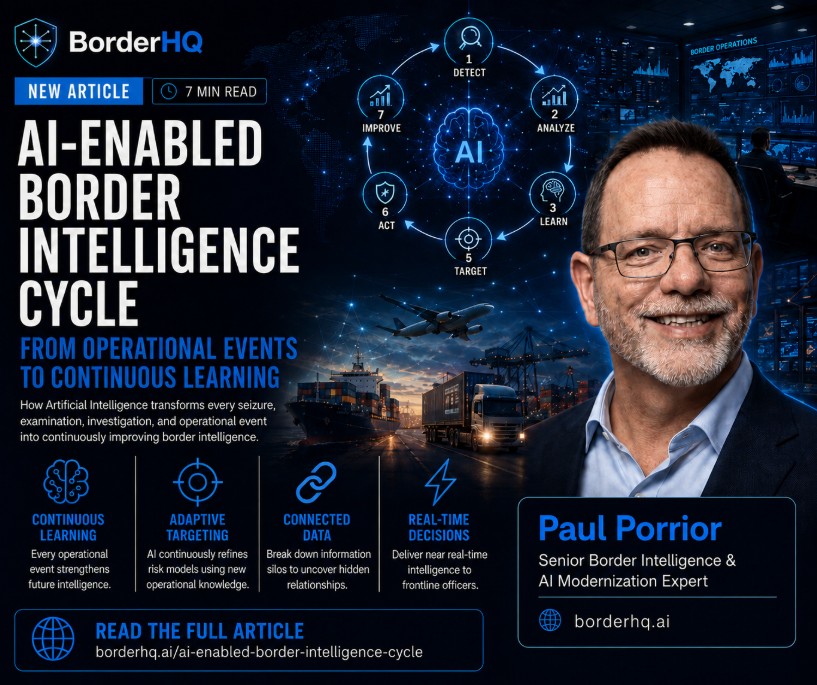
Every border interaction can strengthen border security, whether it results in a significant seizure, a non-resultant examination with noteworthy indicators, an enforcement action, detection technology imagery or a criminal investigation. Traditionally, operational lessons learned are analyzed after the fact and disseminated through intelligence products days or weeks later. Artificial Intelligence (AI) enables this process to occur continuously, transforming operational events into near real-time intelligence that immediately enhances frontline decision-making.
Operational, enforcement, intelligence, and administrative data are often stored in fragmented systems, built primarily for record-keeping and compliance rather than dynamic analysis. That is why valuable signals, and the relationships between them, often surface only after significant delay, if at all.
The AI-Enabled Border Intelligence Cycle addresses this by treating every operational event as an input to the next targeting decision rather than a closed file. Each one sharpens the intelligence picture and the risk assessment that follows.
Continuous Operational Learning
Following a significant seizure or a non-resultant examination containing important indicators, AI can rapidly analyze the complete operational context, including:
- Traveller, crew, conveyance, and cargo information
- Examination findings and officer observations
- Concealment methods and emerging criminal techniques
- Travel routes and transportation patterns
- Commodity and trade information
- Documentation anomalies
- Associated individuals, organizations, vehicles, and locations
- Historical intelligence and enforcement records
AI can rapidly determine whether similar indicators exist elsewhere within active operational systems, allowing emerging threats to be identified while operational opportunities still exist.
Just-in-Time Intelligence
That same intelligence can immediately enhance pre-arrival passenger and commercial targeting by updating dynamic risk indicators. Examples include:
- Emerging concealment methodologies
- New travel and routing patterns
- Commodity-specific risk indicators
- Document fraud techniques
- Supply chain anomalies
- Behavioural indicators
- Organized crime associations
- Newly identified targeting criteria
Rather than waiting for periodic intelligence updates, frontline officers benefit from intelligence that evolves continuously as operational knowledge grows.
Real-Time Operational Awareness
Beyond targeting, AI can continuously monitor active operational systems to identify travellers, conveyances, cargo shipments, or commercial transactions sharing characteristics with newly identified threats.
This supports the ability to identify subjects that are:
- Awaiting arrival in country
- Currently undergoing border processing
- Present within a port of entry
- In transit between operational locations
- Recently released but still within country jurisdiction
- Continuing through domestic or international supply chains
This capability is particularly powerful when applied across datasets that aren't traditionally analyzed together, producing a unified operational picture that increases opportunities for timely intervention.
Adaptive Scenario-Based Targeting
Building on that awareness, AI can continuously refine and build scenario-based targeting rules using combinations of indicators that may not have been previously recognized. Rather than relying on static targeting profiles, AI develops adaptive models that evolve as new intelligence becomes available, improving targeting precision, reducing unnecessary examinations and re-evaluating past outcomes in light of new patterns.
Intelligence and Criminal Investigative Lead Development
That same correlation power extends to investigations: by linking information across multiple operational datasets, AI can identify relationships that may otherwise remain undiscovered.
Potential outputs include:
- Previously unknown criminal associations
- Organized crime networks
- Common addresses and contact information
- Shared transportation routes
- Repeat importers, exporters, or travellers
- Similar concealment methodologies
- Financial or commercial linkages
- Emerging transnational threat patterns
These insights can generate immediate intelligence leads for analysts and investigative opportunities for criminal investigators.
AI-Enhanced Non-Intrusive Inspection (NII) and Contraband Detection
The same principle applies to imaging. Non-Intrusive Inspection (NII) technologies, including X-ray, gamma-ray and other systems used to examine cargo, conveyances, baggage and mail, are a significant source of operational intelligence; when linked with examination outcomes, seizure results, and criminal investigations, AI can continuously learn to recognize concealment methods, anomalous imaging characteristics, commodity irregularities, and emerging smuggling techniques.
By correlating resultant imaging with traveller, cargo, commercial, and enforcement information, AI can identify subtle patterns that may not be readily apparent during manual image interpretation. As new concealment techniques are discovered, validated imaging characteristics can be incorporated into dynamic risk models and automated image analysis algorithms, improving detection accuracy across the border environment.
The integration of NII imagery into the AI-Enabled Border Intelligence Cycle allows every examination, whether it results in a seizure or confirms compliance, to improve future operational effectiveness. Over time, AI continuously refines its ability to distinguish legitimate trade and travel from high-risk activities, supports more consistent image interpretation, identifies previously unseen concealment methodologies, and generates intelligence and investigative leads that strengthen border security while facilitating the efficient movement of legitimate goods and travellers.
The Continuous Intelligence Cycle
The AI-Enabled Border Intelligence Cycle transforms every operational event into an opportunity for continuous organizational learning:
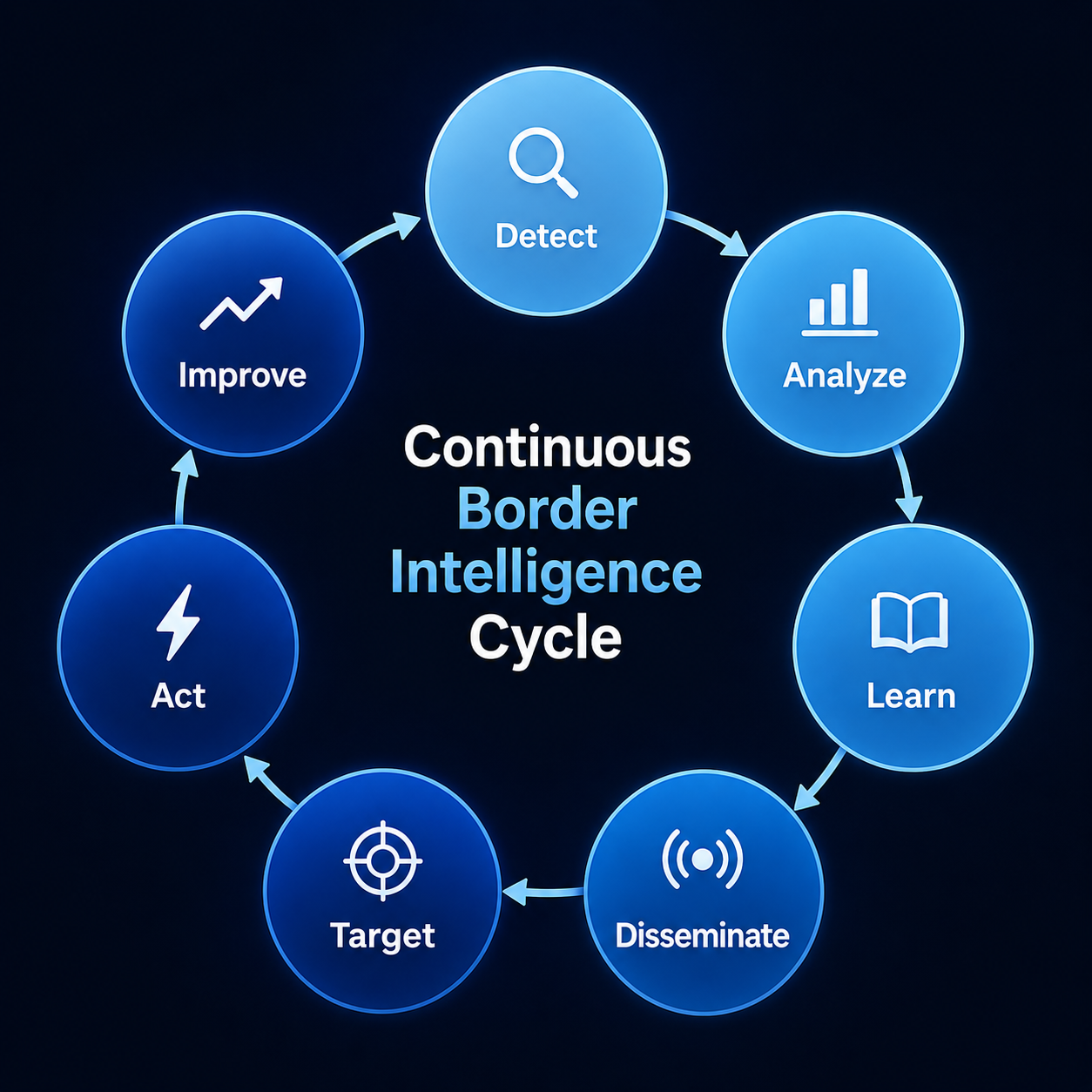
- Detect: Operational events generate new information, much of which is already captured within existing systems.
- Analyze: AI identifies patterns, relationships, and emerging risks across previously siloed datasets.
- Learn: New indicators are validated and incorporated into the intelligence picture.
- Disseminate: Intelligence is delivered to frontline personnel and decision-makers in near real time.
- Target: Risk models and targeting rules are automatically refined.
- Act: Enhanced intelligence supports more informed operational decisions.
- Improve: Every subsequent operational event further strengthens the intelligence cycle.
Strategic Vision
The future of intelligence-led border management lies in turning operational experience into continuous organizational learning, and using the information already sitting in legacy systems rather than leaving it as static records. That shift moves Border Organizations from retrospective, fragmented analysis toward a dynamic intelligence ecosystem where data is continuously connected and operationalized.
In this model, every examination, seizure, investigation, and enforcement action adds new information and puts existing records in a new light.
Operating within robust governance, legal authorities, privacy protections, and human oversight, the AI-Enabled Border Intelligence Cycle speeds up intelligence production, sharpens targeting and gives officers a clearer operational picture, without slowing the legitimate movement of people and goods.